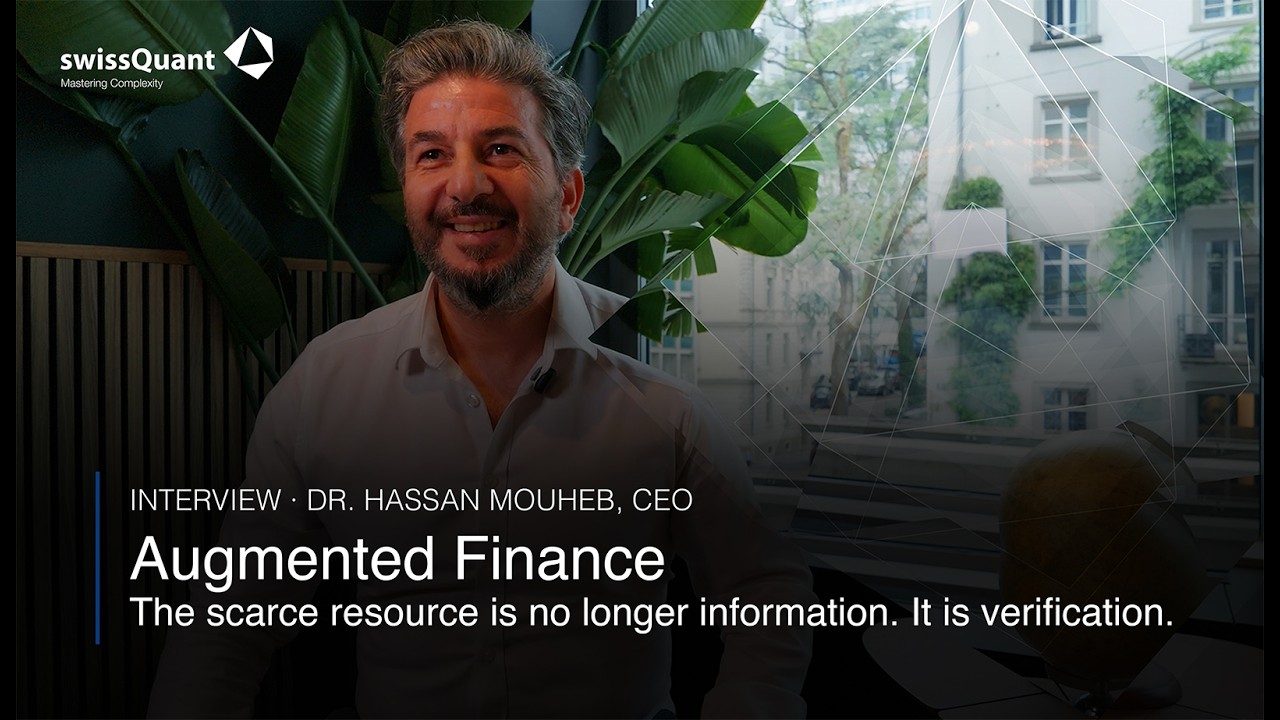
swissQuant CEO Dr. Hassan Mouheb on AI in wealth management. The scarce resource has moved from information to verification, and the adviser's job is now to judge the answer a client brings rather than supply it. He calls the combination Augmented Finance.
This interview was first published in Bilan Magazine on May 27th 2006. We have translated it into English for readers outside the francophone market.
swissQuant CEO Dr. Hassan Mouheb on AI in wealth management: where it adds value, where it does not, and why the question that matters is no longer whether an institution has AI, but what governs it. The thread running through his answers is rigour, models whose assumptions are visible and whose reliability can be measured.
Finance is entering a new phase. But what has actually changed on the clients’ side?
What has changed is the starting point of the conversation. Clients used to arrive with questions. Today they arrive with answers, generated by tools they trust, often with a great deal of confidence. This is not a criticism, it is the new paradigm. The adviser’s role has shifted: it is no longer about supplying the answer, but about assessing the one that is already in the room. It is a subtle shift, but it changes everything.
swissQuant talks about “Augmented Finance”. What do you mean by that?
It is not an elegant way of saying “we are digitalising existing roles”. It is a recognition that AI and quantitative technologies play fundamentally different and complementary roles. LLMs are built to be plausible: remarkable at synthesising, exploring and explaining. Quantitative models are built to be robust on the basis of their assumptions, with quantified uncertainty, and they measure the conditions under which they perform. The scarce resource has changed: it used to be information, today it is verification. “Augmented Finance” is the combination of the two, with rigour as the guiding thread.
In risk management, which uses of AI seem most concrete to you, and what limits should be kept in mind?
The uses are very concrete: trade explanation engines, LLM assistants that let managers shape portfolio constructions, as with Goal-Based Investment, in natural language, and model validation tools. What makes AI really useful is what surrounds it. An LLM can recommend an investment strategy. A quantitative model tells you the conditions under which it remains valid and when to depart from it. The limit not to lose sight of: when millions of people reason through the same tools, their conclusions converge. Risk concentration moves upstream, it no longer sits only in the portfolios but in the reasoning that builds them. This is a new kind of systemic risk, and few people are talking about it yet.
In wealth management, personalisation has become a major issue. How can it be addressed without sacrificing rigour and compliance?
Real personalisation today is the ability to assess the reasoning the client brings with them. An LLM produces clear analyses, but rarely ones calibrated for real constraints: taxation, liquidity, family structure, jurisdiction. What these tools cannot do is robust stress testing, extreme-risk modelling, or optimisation under realistic constraints. The adviser who identifies these gaps and addresses them operates on a layer of value that no standard tool can replace. Compliance is not a brake, it is a competitive advantage: it anchors the advice in the client’s reality.
Swiss private banking has always known how to make the most of information asymmetry. Is that still relevant in the age of AI?
It is, but the asymmetry has changed form. Geographic for two centuries, then structural, such as taxation, multigenerational planning, and cross-border structures. Today it is of a new type: confident lines of reasoning, generated at scale, that arrive directly in the client’s hands. The institution that learned to make the most of the earlier asymmetries is well placed to make the most of this one. AI opens a new market for it. Good news for the Swiss financial centre, provided it understands this quickly.
What will be the real competitiveness factor for the CEO of a private bank, or for a player like swissQuant?
Knowing exactly where AI creates value and where it silently destroys it. Everyone is deploying AI today. The question is no longer whether you have it, it is what governs it. swissQuant’s positioning has been built on twenty years of quantitative models designed for risk management. AI operates inside that framework, not alongside it. It is this combination, mature quantitative infrastructure and an in-house AI team, that is rare. It allows us to be credible on both sides: the institutions that deploy, and the advisers facing clients. The competitiveness factor will not be deployment speed, but the rigour of the framework.
Beyond the tools, this transformation calls for new ways of working. What role should a CEO play to turn it into a real strategic advantage?
The CEO’s role is to advance on two fronts without confusing them. Enthusiasm for AI is legitimate, because the capabilities are real and so are the productivity gains. But the temptation to let the tool redefine the institution is strong. What the CEO must protect is the institution’s DNA. For a private bank, that is the relationship of trust built over decades. For swissQuant, it is quantitative rigour: models whose robustness is measurable and whose assumptions are explicit, models you can rely on because they are designed to be reliable, not merely convincing. AI amplifies this DNA, provided the CEO is clear about what is not negotiable. The vision defines how AI makes us better at what we do, and not different from what we are.