
For wealth and asset management firms, revenue is shaped by a web of decisions, processes, systems, and behaviors. Pricing models, fee schedules, advisor compensation plans, householding rules, discounts, exceptions, approvals, reporting, and compliance requirements all influence how revenue is calculated, captured, distributed, explained, and improved.
Yet in many firms, these functions are still managed separately.
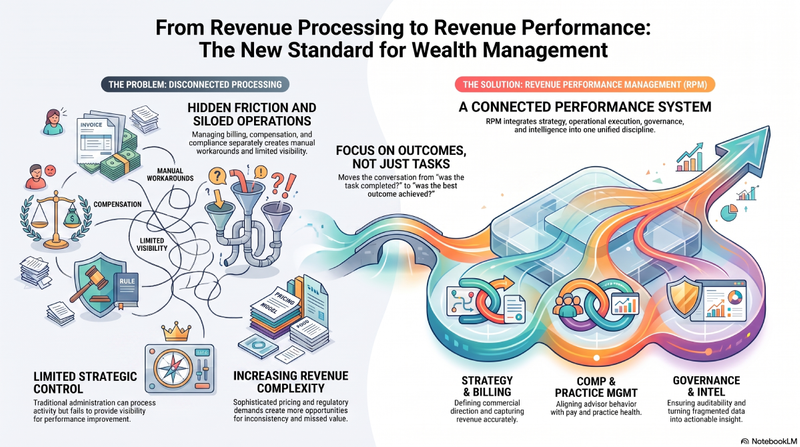
Fee billing operates in one workflow. Advisor compensation runs through another. Practice management relies on separate reporting. Finance, operations, compliance, and advisor-facing teams often work from different views of the same revenue reality.
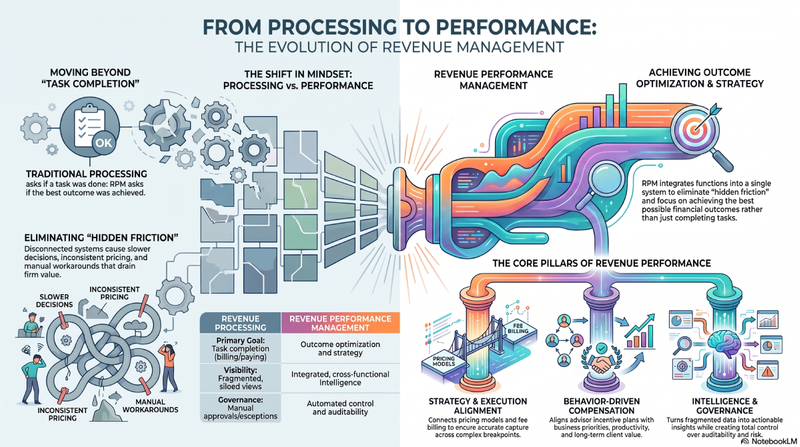
The result is not always obvious failure. More often, it is hidden friction. Slower decisions. Inconsistent pricing. Manual workarounds. Limited visibility. More exceptions. Less confidence in whether revenue is being managed as deliberately as it should be.
That is the role of Revenue Performance Management.
Revenue performance management, defined
Revenue Performance Management is the discipline of connecting revenue strategy, operational execution, governance, advisor behavior, and performance intelligence into one integrated system for managing revenue more effectively.
In wealth and asset management, it helps firms manage the full revenue lifecycle, from pricing and fee calculation to compensation, practice performance, controls, reporting, and optimization.
Put simply, Revenue Performance Management helps firms answer a critical question: Are we managing revenue as a connected performance system, or as a collection of disconnected processes?
That distinction matters because revenue is no longer simple enough to manage after the fact. It must be designed, governed, monitored, and improved continuously.
Why revenue performance management matters
Revenue complexity is increasing.
Firms are managing more sophisticated client relationships, more flexible pricing models, more advisor compensation structures, more regulatory expectations, and more demand for transparency. Each added layer creates more opportunity for inconsistency, inefficiency, and missed value.
Traditional revenue administration can process activity. But it does not always give leaders the visibility or control required to improve performance.
Revenue Performance Management creates a more strategic operating model. It gives firms a clearer way to understand how revenue is created, where it is at risk, how it moves through the business, and where better decisions can be made.
This is where elite revenue solutions become essential. Firms do not need another isolated tool for one narrow workflow. They need connected capabilities that help leaders see the full revenue picture and manage it with greater confidence.
The core elements of revenue performance management
Revenue Performance Management is built around six interconnected domains that determine how effectively a firm's revenue engine operates.
- Strategy defines what products and services the firm offers, which clients they serve, and how those services should be priced. It establishes the commercial direction that drives profitable growth.
- Alignment ensures advisor incentives support the firm's strategy. Compensation structures, performance measures, and rewards are designed to encourage the behaviors that create long-term business value.
- Execution translates strategy into consistent operational outcomes. Pricing policies, fee schedules, billing, workflows, and controls are implemented reliably across front, middle, and back office operations.
- Transparency creates confidence that everyone is working from the same understanding of revenue. Clients, advisors, operations, finance, and leadership can trust, explain, and reconcile how revenue is calculated and distributed.
- Governance establishes the controls needed to support business objectives, regulatory compliance, and risk management. It strengthens oversight through consistent policies, approvals, auditability, and accountability.
- Intelligence transforms operational and financial data into actionable insight. Firms can identify trends, measure performance, uncover opportunities, and make better decisions to continuously improve revenue outcomes.
Together, these six domains create a connected framework that helps wealth and asset management firms move beyond task completion and towards active revenue performance management; optimizing revenue growth while reducing operational risk.
From revenue processing to revenue performance
Many firms are highly capable at processing revenue.
They can calculate fees, send invoices, pay advisors, produce reports, and resolve exceptions. Those functions are necessary. But they are not the same as managing revenue performance.
Revenue processing asks, was the task completed?
Revenue Performance Management asks, was the best revenue outcome achieved?
That shift changes the conversation.
A fee may be calculated correctly, but the pricing model may no longer reflect the value delivered. An advisor may be paid accurately, but the compensation plan may not reinforce the right behaviors. A report may be technically correct, but arrive too late to influence action. An exception may be resolved, but the pattern behind it may remain invisible.
Revenue Performance Management helps firms identify those patterns and act on them.
It creates the visibility to understand what is happening, the governance to trust the numbers, and the intelligence to improve decisions over time.
Why it matters across the firm
Revenue Performance Management is not owned by one department.
- For CEOs, it creates a more reliable view of how the business is performing and where value can be improved.
- For CFOs, it strengthens revenue integrity, margin visibility, and forecast confidence.
- For COOs, it reduces operational complexity and improves control across revenue processes.
- For risk and compliance leaders, it supports greater transparency, auditability, and consistency.
- For advisor-facing leaders, it connects practice performance, pricing discipline, and advisor behavior to firm priorities.
- For advisors, it provides clearer insight into compensation, client economics, and opportunities to improve the health of their business.
That cross-functional impact is what makes Revenue Performance Management so important. Revenue touches the entire firm. Managing it well requires an integrated approach.
Revenue as a managed Pperformance system
Revenue should not be treated as a set of disconnected back-office activities.
It is where strategy, operations, behavior, governance, and intelligence come together.
Revenue Performance Management gives wealth and asset management firms a better way to manage that intersection. It helps leaders see revenue more clearly, control it more effectively, and improve it more consistently.
In a market where complexity keeps rising, the firms that manage revenue as a connected performance system will be better equipped to protect margins, strengthen confidence, reduce operational drag, and make smarter decisions.
That is the promise of Revenue Performance Management.
Not simply faster processing.
Better performance.
Read the original article here.
