
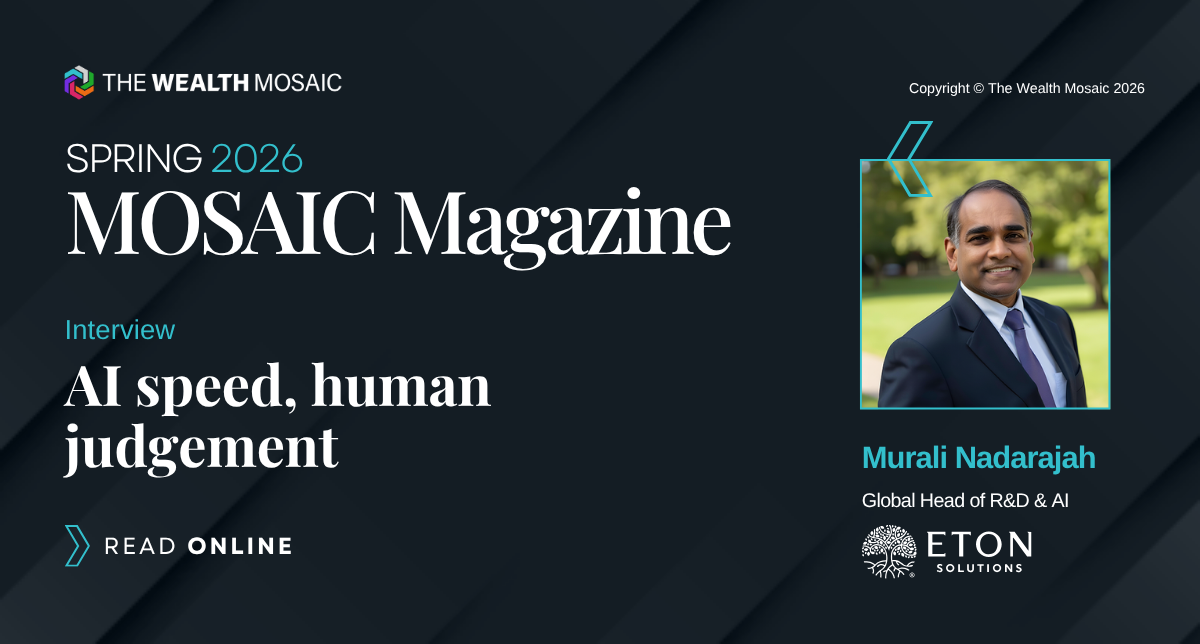
Eton Solutions’ Murali Nadarajah tells TWM how human-governed AI models can scale family office operations and what he’s learned from 40 years of working in artificial intelligence.
Tell us about yourself and your role at Eton Solutions.
I’m the Global Head of R&D and AI at Eton Solutions, and I’ve worked in artificial intelligence (AI) for about 40 years. Honestly, about 36 of those were what we call the AI winters—lots of promise but very little real-world adoption. The advantage of living through those cycles is that you learn what actually works in enterprise environments and what doesn’t. Today we’re finally at the point where AI can move from experimentation to operational impact.
Tell us about Eton Solutions and its offering in this space.
Wealth management historically lacked a true enterprise operating platform. Eton Solutions was founded in 2015 with a mission to build the enterprise resource planning (ERP) software for wealth management. A decade later, we manage over US$1.4 trillion in assets on our platform, covering investment accounting, partnership accounting, tax, and trust – the full operational backbone of a modern family office.
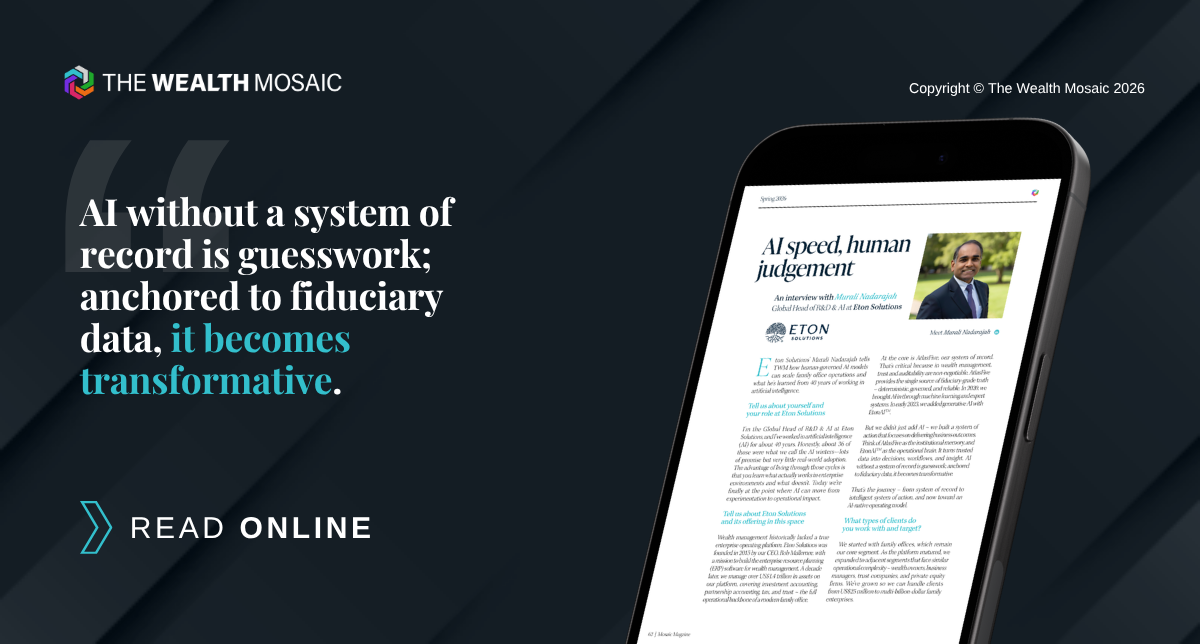
At the core is AtlasFive, our system of record. That’s critical because in wealth management, trust and auditability are non-negotiable. AtlasFive provides the single source of fiduciary-grade truth – deterministic, governed, and reliable. In 2020, we brought AI in through machine learning and expert systems. In early 2023, we added generative AI with EtonAI. But we didn’t just add AI – we built a system of action that focuses on delivering business outcomes. Think of AtlasFive as the institutional memory, and EtonAI as the operational brain. It turns trusted data into decisions, workflows, and insight. AI without a system of record is guesswork; anchored to fiduciary data, it becomes transformative.
That’s the journey – from system of record to intelligent system of action, and now toward an AI-native operating model.
What types of clients do you work with and target?
We started with family offices, which remain our core segment. As the platform matured, we expanded to adjacent segments that face similar operational complexity – wealth owners, business managers, trust companies, and private equity firms. We’ve grown so we can handle clients from US$25 million to multi-billion-dollar family enterprises.
What components make up the EtonAI solution?
EtonAI’s two core components are the co-pilot and agentic automation. The co-pilot is the conversational interface – users simply ask it to execute tasks, whether that’s updating a beneficiary or running a query. It interprets, acts in AtlasFive or connected systems, and returns results – streamlining human decision-making.
The agentic layer is a suite of autonomous agents that handle repeatable workflows – retrieving fund documents, classifying transactions, and routing them downstream – operating independently but within strict governance. Together, the co-pilot enables guided action. The agents deliver scalable execution.
The key shift is that AI is no longer just an interface – it’s becoming an execution layer that can complete operational work across systems.
What problems were you trying to solve when you founded EtonAI?
AtlasFive is a powerful system of record, processing investment, accounting, tax, and trust data with fiduciary precision. But even the best system of record doesn’t complete the work. It stores truth but it doesn’t reason.
EtonAI closes that gap. It’s an AI reasoning and decisioning engine layered on AtlasFive that doesn’t just surface data – it executes workflows and delivers outcomes – reconciliations, allocations, validations, approvals – the operational heavy lifting. For clients, this is critical because scale in wealth management doesn’t break at the ledger, it breaks in the human bottleneck. Month-end close, capital call processing, transaction validation – these are judgement-heavy, repetitive processes that consume time and create operational risk.
That’s where our ‘Maker–Checker–Learner’ model becomes strategic. AI acts as the Maker – drafting, classifying, preparing. The human remains the Checker – providing fiduciary oversight and approval. The Learner captures corrections and edge cases, reinforcing them into the system.
Over time, the platform learns from exceptions, allocation nuances, and entity structures – so fewer repeat errors, less rework, and compounding efficiency gains. This model mirrors existing financial governance structures – separation of duties, review, and continuous learning. For customers, this isn’t just automation. It’s adaptive operational intelligence – real scale without losing governance.
What are the key characteristics and benefits of EtonAI?
First: productivity. We deliver a 30 percent improvement at minimum; in some workflows – like approvals or document processing – we’ve seen eight-times gains. Two-hour tasks now take five minutes. Month-end close and mark-to-market are prime examples. The point isn’t incremental efficiency – it’s step-change acceleration. AI changes the economics of operations. Work that previously required teams can now be executed as intelligent workflows.
The second is decision quality. EtonAI doesn’t just speed up approvals; it enriches them. A capital call decision, for example, can be evaluated instantly against commitments, historical allocations, fund performance, liquidity positions, and contractual terms. Instead of acting on one or two data points, clients act on full-context intelligence. It means faster and better decisions.
Finally, expansion of capability. We call it eliminating the ‘embarrassment tax’. AI gives teams the ability to interrogate tax filings, partnership structures, or performance drivers before speaking to external advisers. You’re not replacing experts – you’re showing up to the conversation informed. That elevates the quality of governance across the organisation.
The impact is clear: more output; better judgement; broader capability – all without adding headcount.
Interested in reading more about Eton Solutions’ interview? Mosaic I is available to read in full here.
What have you learned from your AI deployments in recent years?
That enterprise AI deals in probabilities, not absolutes. If the AI is 85 percent correct, that’s powerful – but only if you know exactly which 15 percent needs human correction. The process must be built so that every decision point is transparent and auditable – you know what the AI got right, and exactly where a human steps in.
That’s why enterprise AI isn’t like a B2C chatbot. Chatbots offer answers, but enterprise AI must deliver governed outcomes. EtonAI was built for B2B: every step is explainable, auditable, and scalable. We learned that success comes from combining AI’s speed with human judgement at the right moments. So, AI doesn’t replace governance – it makes it scalable and smarter every step of the way.
Enterprise AI isn’t about perfect answers – it’s about governed outcomes.
What's next on the roadmap for Eton Solutions?
We’re currently rolling out EtonAI 2.0 to deliver a much broader range of completed operational outcomes, not just task-level assistance. The industry is moving from systems that record activity to systems that complete work autonomously. Historically, our AI capabilities were concentrated within AtlasFive, helping automate activities such as document processing, data extraction, and transaction handling. The next phase expands this capability so that EtonAI can coordinate work across the systems family offices rely on – investment platforms, CRM systems, document repositories, and external data sources.
The goal is to move to AI that completes entire operational jobs – daily data updates, assembling reports, reconciling transactions, organising documents, or month-end close support. As automated outcomes increase, operations teams will spend less time on manual coordination and exception handling and more on oversight, decision-making, and governance – ensuring accuracy, reviewing exceptions, and managing the increasingly complex financial environments that family offices operate in.
So, the roadmap is about delivering more operational outcomes through AI, while enabling people to concentrate on higher-level activities that require judgement, control, and accountability.
What trends do you see shaping the wealth management sector and how is Eton Solutions supporting them?
For decades, competitive advantage in wealth management came from owning proprietary data. Today, most firms have access to similar data sources. Value has shifted to orchestrating that data using AI. The move from simple AI assistants to agentic AI operating models is key.
Earlier systems summarised information; today AI can execute multi-step operational workflows – such as data aggregation, reconciliation, reporting, and document processing. EtonAI acts as an operational intelligence layer, completing work across the family office rather than supporting individual tasks.
Another major trend is the ‘unified client brain’: consolidated views of clients across investments, entities, documents, and life events, enabling personalised service at scale. AtlasFive, combined with EtonAI, integrates operational data, documents, and workflows into a unified environment where intelligence is applied consistently across the client relationship. As wealth becomes more mobile, firms need systems that can manage complexity while maintaining transparency and compliance.
This is where AtlasFive and EtonAI come together: AtlasFive provides the operational system of record, while EtonAI provides the intelligence layer that helps manage workflows and decisions across that environment. Success will be defined less by who owns the most data and more by who can manage complexity with the greatest transparency and trust.
Interested in reading more about the news, insights, and trends shaping wealth management today? Mosaic I is available to read in full here.

Want to feature in Mosaic II?
Work on Mosaic II: Summer 2026 is already underway. If you would like to feature in the next edition, you can discover the range of contribution options available here.
About The Wealth Mosaic
The Wealth Mosaic is a UK-headquartered online solution provider directory and knowledge resource, focused specifically on the wealth management industry.
For wealth managers, the buy side of our marketplace, The Wealth Mosaic is designed to enable discovery of key solutions, solution providers and knowledge resources by specific business needs.
For solution providers and vendors, the sell side of our marketplace, The Wealth Mosaic exists to support the positioning, exposure and business development needs of these firms in a more complex and demanding market.
Interested in discovering more? Read our reports!
- WealthTech 2026 – read here
- US RIA Toolkit 2026 – read here
- Future View Toolkit 2025 – read here
- UK Toolkit 2025 – read here
- AI Toolkit 2025 – read here
- Client Experience Toolkit 2024 – read here
- US WealthTech Landscape Report 2024 – read here
Join our community and follow us on LinkedIn here.
