

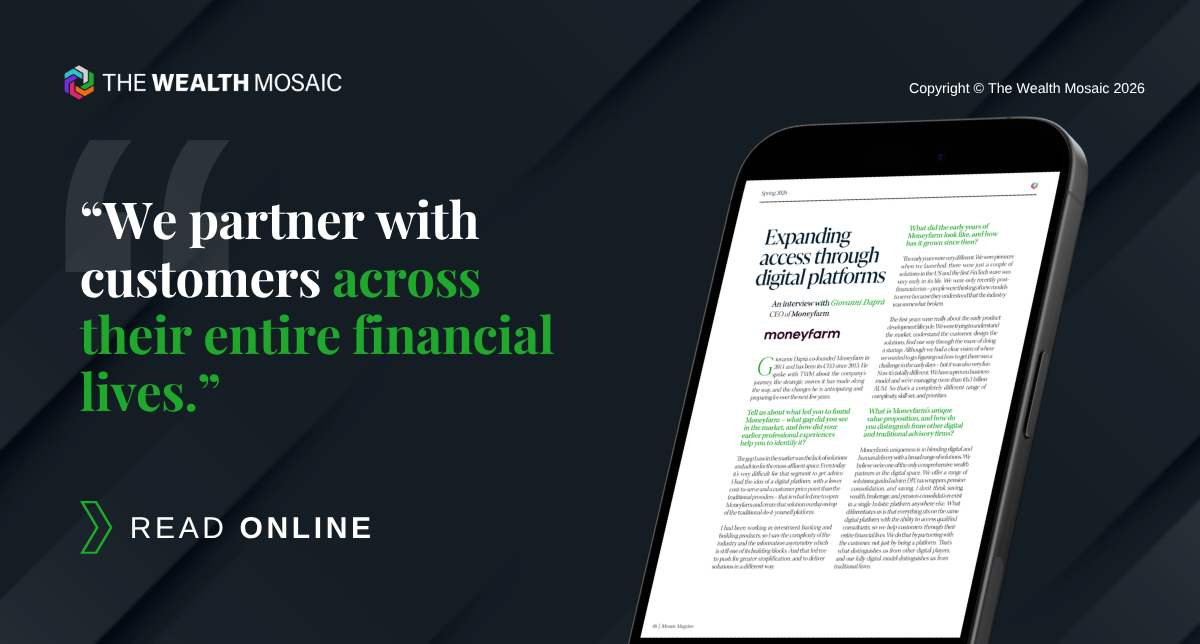
Giovanni Daprà co-founded Moneyfarm in 2011 and has been its CEO since 2013. He spoke with TWM about the company’s journey, the strategic moves it has made along the way, and the changes he is anticipating and preparing for over the next few years.
Tell us about what led you to found Moneyfarm – what gap did you see in the market, and how did your earlier professional experiences help you to identify it?
The gap I saw in the market was the lack of solutions and advice for the mass-affluent space. Even today it’s very difficult for that segment to get advice. I had the idea of a digital platform, with a lower cost-to-serve and a customer price point than the traditional providers – that is what led me to open Moneyfarm and create that solution overlay on top of the traditional do-it-yourself platform.
I had been working in investment banking and building products, so I saw the complexity of the industry and the information asymmetry which is still one of its building blocks. And that led me to push for greater simplification, and to deliver solutions in a different way.
What did the early years of Moneyfarm look like, and how has it grown since then?
The early years were very different. We were pioneers: when we launched, there were just a couple of solutions in the US and the first FinTech wave was very early in its life. We were only recently post-financial crisis – people were thinking of new models to serve because they understood that the industry was somewhat broken.
The first years were really about the early product development lifecycle. We were trying to understand the market, understand the customer, design the solutions, find our way through the maze of doing a startup. Although we had a clear vision where we wanted to go, figuring out how to get there was a challenge in the early days – but it was also very fun.
Now it's totally different. We have a proven business model and we're managing more than €6.3 billion AUM. So that's a completely different range of complexity, skill-set, and priorities.
What is Moneyfarm’s unique value proposition, and how do you distinguish from other digital and traditional advisory firms?
Moneyfarm’s uniqueness is in blending digital and human delivery with a broad range of solutions. We believe we're one of the only comprehensive wealth partners in the digital space. We offer a range of solutions: guided advice, DIY, tax wrappers, pension consolidation, and saving. I don't think saving, wealth, brokerage, and pension consolidation exist in a single holistic platform anywhere else. What differentiates us is that everything sits on the same digital platform with the ability to access qualified consultants, so we help customers through their entire financial lives. We do that by partnering with the customer, not just by being a platform. That's what distinguishes us from other digital players, and our fully digital model distinguishes us from traditional firms.
A core aspect of Moneyfarm’s model has been the blend of technology with human insight – how has that hybrid approach evolved over its lifetime, and what have the new technologies that have emerged over the last 15 years enabled?
In the last 15 years, improvements in digital interfaces, digital onboarding, and tools for engagement have really allowed us to execute on our hybrid model. Mobile technology, the fact that you can log into the app as many times a day as you like, creates many more touchpoints that allow us to be present for you and your family. Data automation and integration are now easier to implement. Consumers are more open to video calls rather than face-to-face meetings. The combination of technology adoption allows a different level of engagement. And since 2024, we’ve started to talk about artificial intelligence (AI) – that’s a different paradigm, but more for the future than the present.
What strategic moves have most reshaped your business model and goals?
There have been three big moments in Moneyfarm’s history. One is when we expanded into the UK in 2015, after starting in Italy, to build upon our European business: that was a pivotal decision. The other decision was launching a B2B2C proposition with our first customers in Italy. Working with partners, we were able to combine our platform engagement model and technology to enhance distribution. That started in 2018; now we have over €1 billion in the B2B2C channel, and the platform service has really accelerated.
The third big moment was our product expansion between 2022 and 2024. We started with the wealth vertical; then we saw a convergence of brokerage, pension consolidation, and saving. In two years, including through acquisition, we expanded from just being a wealth provider to brokerage and pension consolidation. That gave us scale, but also the ability to allow for broader entry points which allows the platform to grow faster.
Interested in reading more about Moneyfarm’s interview? Mosaic I is available to read in full here.
How have regulatory expectations from the FCA, CONSOB, and others influenced your product design, client engagement, and innovation roadmap?
I always tell the team that the customer should influence more than the regulator: the customer comes first. We want to do what's right for the customer, and then we ensure we meet the regulatory expectation. I think that it's important to embed those regulatory expectations into the design of the product, otherwise you risk finding yourself short and spending time and money to recover. It's an advantage to have a strong framework to embed this into product design very early on. So there is an influence – but I think the customer should influence more.
Where do you see Moneyfarm’s place in the European wealth management market today, and how do you see it growing over the course of the next decade?
I see it as uniquely positioned. We are one of only a few companies to successfully scale in two different geographies, with a broad proposition spanning wealth, savings, brokerage, and pension consolidation. We are one of very few companies in the digital platforms space that have reached a certain scale. I see this as a continuous opportunity. Digital investing is accelerating, brokerage is accelerating, ETFs are accelerating, and these are all things that we have either pioneered or been participating in for a long time. We have the right skill-set, competencies, and team for success.
What trends in the wealth management sector – including in technology, client behaviour, or regulation – are you anticipating and preparing for, and how do you see those shaping the sector more broadly over the next five years?
I believe there are several big changes that will impact the wealth management business. The first is that people are craving more simplicity, more accessibility. This is not going to change – if anything, new digital providers create expectations that customer also want in wealth management.
The second is the search for empowerment: people want to be more engaged, particularly the younger generation. Post-Covid, post-crypto, people are way more engaged, way more willing to do it themselves than before.
Personalisation is another big trend: even though the needs are similar, people want to be able to personalise and participate in the management of their money.
Another point is that financial life is increasingly complex. Life is becoming more expensive on the one hand; on the other, complexity has increased, and so does the need for advice and guidance. If you don't manage your retirement and pension well, you're not going to be able to buy a house or to afford retirement. That's a critical need, and incumbents are catching up; they're starting to realise that digital is here to stay. We're starting to see digital business models that scale, and that also creates opportunities for B2B2C and for our partnership ecosystem to evolve.
What have been your biggest surprises and most important lessons over the course of Moneyfarm’s lifetime – both in building the business and driving innovation in wealth management more broadly?
I think one of the biggest surprises is that people are still willing to pay a lot for the peace of mind of wealth management services, even face-to-face advice. I thought originally that would change much faster as people become more savvy and better able to assess the value of those services. The other is the range of competencies needed to run a digital wealth management business – it surprised me how complex wealth management is, and it’s difficult for people not in wealth management to really understand that complexity.
Looking back on your own journey as a co-founder and CEO, how has building Moneyfarm changed the way you personally think about wealth, risk, and long-term decision-making – both as a business leader and as an investor?
It hasn't changed a lot because I always had a long-term approach to wealth. Maybe I’ve become more patient because it takes a long time to scale this kind of business, probably more than I envisioned at the beginning. But I always thought about being long-term greedy rather than short-term greedy. It's about playing the long game and I don't think that has changed.
Interested in reading more about the news, insights, and trends shaping wealth management today? Mosaic I is available to read in full here.

Want to feature in Mosaic II?
Work on Mosaic II: Summer 2026 is already underway. If you would like to feature in the next edition, you can discover the range of contribution options available here.
About The Wealth Mosaic
The Wealth Mosaic is a UK-headquartered online solution provider directory and knowledge resource, focused specifically on the wealth management industry.
For wealth managers, the buy side of our marketplace, The Wealth Mosaic is designed to enable discovery of key solutions, solution providers and knowledge resources by specific business needs.
For solution providers and vendors, the sell side of our marketplace, The Wealth Mosaic exists to support the positioning, exposure and business development needs of these firms in a more complex and demanding market.
Interested in discovering more? Read our reports!
- WealthTech 2026 – read here
- US RIA Toolkit 2026 – read here
- Future View Toolkit 2025 – read here
- UK Toolkit 2025 – read here
- AI Toolkit 2025 – read here
- Client Experience Toolkit 2024 – read here
- US WealthTech Landscape Report 2024 – read here
Join our community and follow us on LinkedIn here.
